
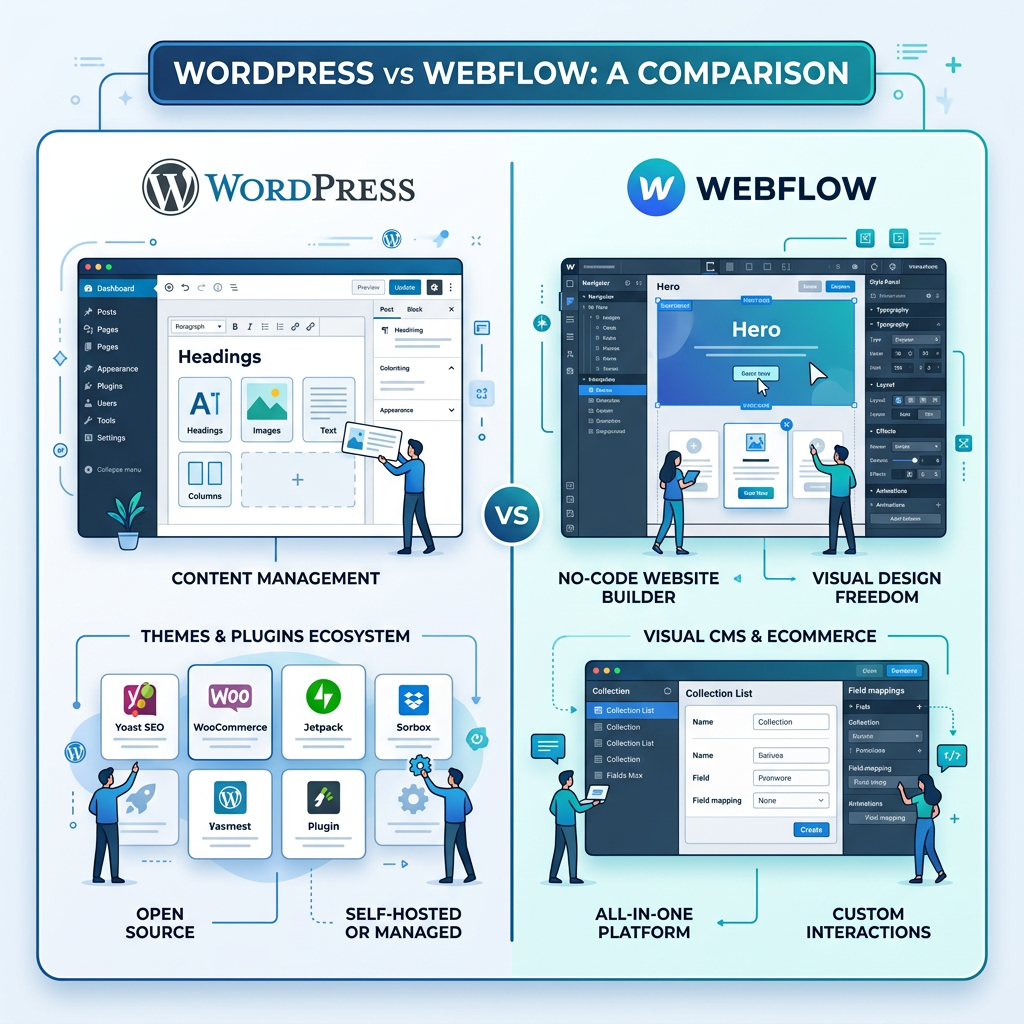
WordPress vs Webflow for growing marketing teams
At first, this often feels like a design decision.
Which platform looks cleaner. Which one feels more modern. Which one gives marketing more control without relying too heavily on developers.
That is usually where teams begin.
But as a business grows, the website stops being just a design project. It becomes a working part of the marketing engine. It has to support campaigns, landing pages, SEO, content, lead capture, integrations, internal workflows, and future growth.
That is where the WordPress versus Webflow decision becomes much more important.
Both platforms can support a strong website. Both can look polished. Both can perform well. But for a growing marketing team, the real question is not which one feels easier at launch.
It is this:
Which platform will still support the business well once marketing needs become more demanding?
The short answer
Webflow can be a strong fit when the site is relatively contained, design-led, and not expected to become deeply complex in the near future.
WordPress is usually the better long-term choice when the website is expected to grow into a larger marketing asset with deeper SEO, more content, stronger integrations, and more flexibility.
Webflow often feels easier early on.
WordPress usually becomes more valuable as the business grows.
Where teams often get this wrong
Many teams choose based on what makes the next few weeks easier.
That is understandable. Launch pressure is real. Everyone wants speed. Everyone wants a polished result. And everyone wants fewer moving parts.
But the first version of the website is rarely the final job the website will be asked to do.
Soon the business wants more:
- More landing pages
- More lead magnets
- More content depth
- Better SEO structure
- More campaign flexibility
- Cleaner integrations with CRM and automation tools
- Better internal publishing workflows
- More room to expand without rebuilding
This is where early platform choices start to show their limits.
A platform rarely becomes a problem all at once. It usually becomes a problem gradually. Each new request becomes slightly harder. Each workaround adds friction. And eventually the website still looks fine, but it no longer supports growth as well as it should.
When Webflow makes sense
Webflow is a good choice when:
- The site is relatively small
- The content structure is straightforward
- Design polish is a major priority
- The team values visual control
- Long-term technical complexity is expected to stay limited
For these situations, Webflow can be efficient and attractive. It can help a team move faster, launch something clean, and maintain a modern-looking site without inheriting unnecessary complexity too early.
That is a real strength.
The problem is not Webflow itself. The problem is assuming that what works well for a smaller marketing operation will automatically work just as well once the business needs more from the site.
When WordPress becomes the better choice
WordPress becomes more compelling when the website needs to do more than present information.
It becomes stronger when the site needs to support:
- Content libraries
- Case studies
- Lead magnets
- Service hubs
- SEO expansion
- Landing page systems
- Custom templates
- CRM workflows
- Advanced integrations
- Editorial structure
- Future customization
This is where WordPress tends to pull ahead.
A well-built WordPress site gives a business more room to shape the website around how the company actually operates. That flexibility matters when the marketing team is growing, the content strategy is getting deeper, and the website is expected to support more than a handful of static pages.
SEO and content growth
A lot of platform comparisons oversimplify SEO.
Neither platform ranks just because of the name attached to it. Good SEO still depends on content quality, search intent, site structure, internal linking, technical discipline, and consistency over time.
The more useful question is this:
Which platform gives your team more room to keep doing SEO well as the site expands?
For many growing teams, that answer is WordPress.
Not because Webflow cannot rank. It can. But once the SEO program grows beyond a small set of pages and becomes a larger content and architecture effort, WordPress often offers more breathing room.
That matters when your site needs to support:
- Resource content
- Comparison pages
- Case studies
- Internal linking systems
- Service clusters
- Structured expansion over time
A growing marketing team does not just need a website that can rank. It needs a website that can keep evolving without becoming harder to manage every quarter.
Integrations and business reality
This is where many comparison articles become too theoretical.
The website is rarely working alone.
It eventually needs to connect with:
- CRM systems
- Email platforms
- Form tools
- Scheduling tools
- Analytics
- Automation platforms
- Ecommerce systems
- Internal business workflows
As those needs become more specific, flexibility matters more.
WordPress tends to become more attractive when the website needs to work as part of a larger operating system rather than just a front-end marketing layer.
That is often the difference between a site that simply looks good and one that actually helps the business run better.
Cost over time
Most teams compare cost too narrowly.
They look at launch cost, setup speed, and visible simplicity. What they often miss is the cost of resistance later.
How expensive does the platform become once the business wants more? How often do workarounds start replacing clean solutions? How likely is the team to revisit the platform decision in a year or two?
That is where short-term efficiency can become long-term expense.
The best platform is not always the one that gets you online fastest. It is the one that remains useful after growth arrives.
Final verdict
Webflow is a strong platform. For some businesses, it is exactly the right answer.
But for growing marketing teams that expect the website to become a deeper marketing asset with more content, more SEO, more systems, and more complexity, WordPress is often the better long-term foundation.
That is not because one platform is universally better.
It is because growing teams need room. And in many cases, WordPress gives them more of it.