

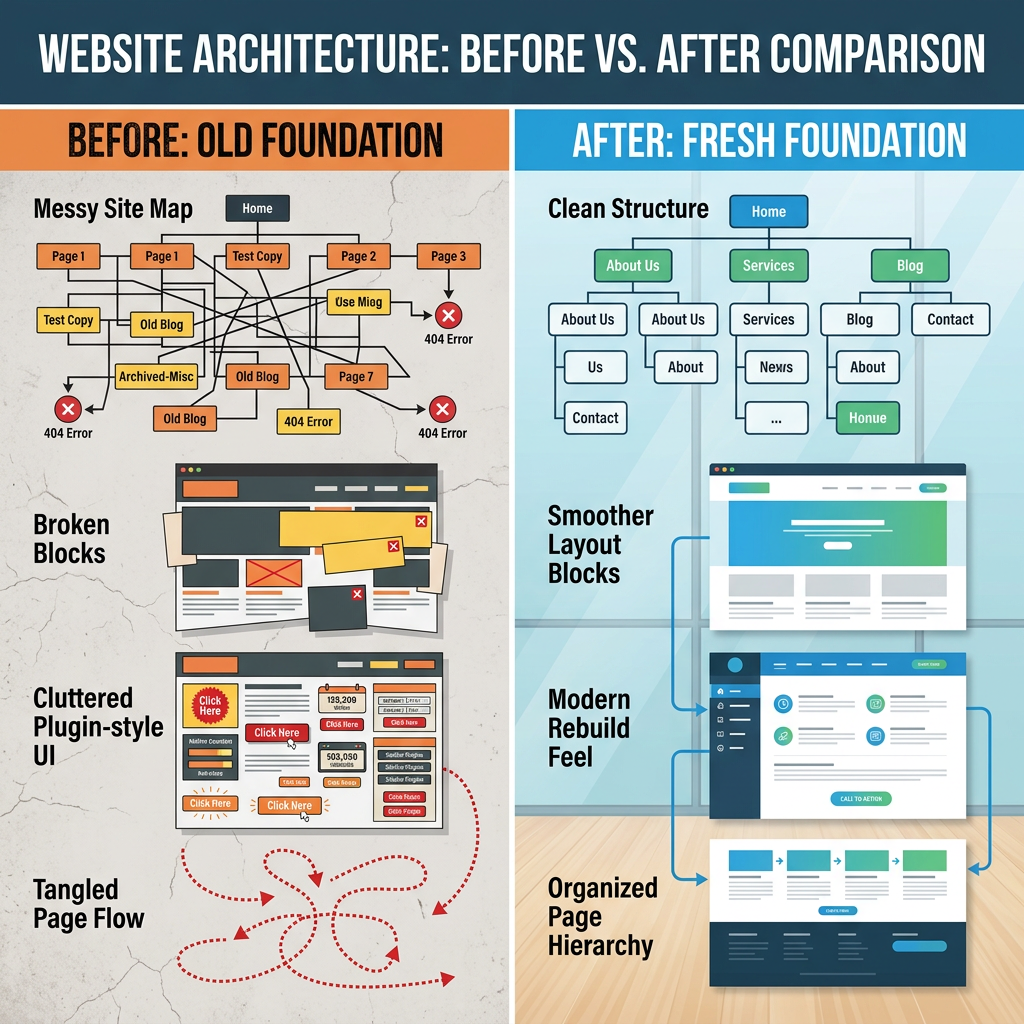
This is one of the most important website decisions a business can make.
On one side, rebuilding what already exists can feel smarter, faster, and more affordable. On the other, starting fresh can seem like the cleanest way to escape years of technical debt, design compromises, and fragile setups.
The problem is that many teams choose emotionally.
They have already spent money on the current site, so they want to save it. Or they are frustrated with everything, so they want to throw it all out and begin again.
Neither instinct is always right.
The better question is much simpler:
Will improving the existing site create real forward momentum, or will it keep you stuck on a compromised foundation?
The short answer
Rebuild the existing WordPress site when the core setup is still usable and the main problems are design, structure, performance, or content strategy.
Start fresh when the site is being held back by poor architecture, plugin bloat, fragile customizations, inconsistent templates, or a setup that will keep creating friction every time the business grows.
A website should not be judged only by how it looks.
It should be judged by how well it supports what the business needs next.
When rebuilding the existing site makes sense
Rebuilding can be the smarter move when the underlying foundation still has value.
That usually means:
- The CMS setup is stable
- The URL structure is mostly sound
- The content can be reused
- The site is not buried under bad custom code
- The main issues are visual, structural, or strategic rather than foundational
In these situations, reworking what already exists can save time and reduce unnecessary disruption.
A rebuild often makes sense when you need:
- Better messaging
- Better conversion paths
- Cleaner design
- Improved mobile experience
- Faster load times
- Smarter internal linking
- Better use of existing content
If the bones are good, a smart rebuild can take the site much further without forcing a complete reset.
When starting fresh is the better move
Sometimes the site is not a foundation. It is a liability.
This usually shows up in familiar ways:
- Too many plugins are holding the site together
- No one fully understands how it was built
- The theme is bloated or hard to maintain
- Simple changes break other parts of the site
- Performance stays poor even after repeated fixes
- The admin experience is messy or confusing
- Templates are inconsistent
- Growth keeps running into structural limits
At that point, continuing to patch the site may feel productive, but it is often just preserving the problem.
You spend more energy working around the system than improving the business.
That is usually the moment to start fresh.
A clean build gives you the chance to reset:
- Structure
- Performance
- Template logic
- Editorial workflows
- Integrations
- Conversion paths
- Governance
- Scalability
That kind of reset can be worth far more than another round of repairs.
The biggest mistake teams make
They compare cost too narrowly.
They ask:
- Is a rebuild cheaper?
- Is a fresh build more expensive?
- Can we save time by keeping what we have?
Those questions matter, but they are incomplete.
The real cost is not just project cost. It is the cost of what happens after launch.
If you rebuild a site that still has deep structural issues, you may end up paying twice:
- Once to improve it
- And again to replace it later
That is why the cheaper option upfront is not always the smarter one overall.
The goal is not to save the existing site at all costs. The goal is to choose the path that creates the stronger long-term asset.
SEO considerations
This part matters more than many businesses expect.
If the current site has valuable rankings, indexed pages, useful content, and strong URLs, rebuilding carefully can help preserve that value.
But if the existing structure is weak, thin, or poorly organized, starting fresh can sometimes improve search performance over time, provided the migration is handled properly.
Before deciding, you should review:
- Current top-performing URLs
- Indexed pages
- Redirect strategy
- Metadata
- Canonicals
- Internal links
- Sitemap quality
- Thin or low-value pages
A fresh build can be good for SEO.
A careless fresh build can also wipe out momentum that took time to build.
That is why this decision should never be made on design alone.
A practical decision framework
Choose to rebuild the existing site if:
- The core setup is stable
- The structure is mostly sound
- The content is still valuable
- Performance issues are fixable
- The main problem is positioning, UX, or presentation
Choose to start fresh if:
- The site is technically fragile
- Build quality is poor
- The backend is hard to manage
- Growth keeps hitting structural limits
- Every improvement feels harder than it should
- You no longer trust the foundation
This is the simplest test:
If the existing site can be improved without carrying forward tomorrow’s problems, rebuild it. If every improvement still leaves you with a compromised foundation, start fresh.
Final verdict
Rebuilding an existing WordPress site is a smart move when the foundation still has real life in it.
Starting fresh is the better move when the current site has become too fragile, too limiting, or too expensive to keep carrying forward.
The right choice is not the one that feels safest emotionally.
It is the one that gives the business a better platform for the next phase of growth.